Real Israeli use cases worked end-to-end
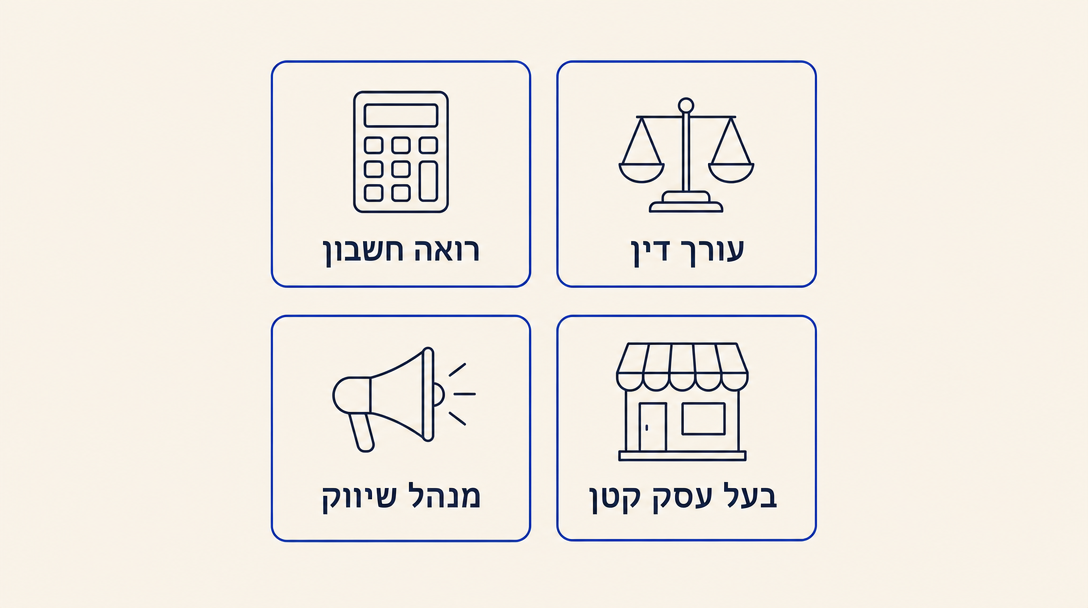
This chapter shows four complete workflows, one per professional role. For each, you get the agent setup (the instructions you save once), the daily use pattern (what you do every time), and what to verify before acting on the output. Treat these as templates to adapt to your specific situation.
Use case 1: Freelance accountant prepares monthly VAT report draft
Agent setup (saved as a Claude Project or ChatGPT GPT once):
"Role: Israeli accounting assistant for freelancers (osek murshe). Task: When the user pastes a list of monthly invoices, each with a category label the USER provided (חייב במע"מ / שיעור אפס / פטור), produce a draft VAT report organized by category. Constraints: VAT rate 18% (since January 2025). Do NOT re-classify invoices yourself; use only the user-provided labels. Flag any invoice the user marked as 'אפס' or 'פטור' to remind them these have different input-VAT treatment. Note: chat agents are unreliable at arithmetic over many invoices; treat all totals as a draft to verify, not a final number. Format: Markdown table with one row per invoice plus a totals row at the bottom. Always end with a numbered list of 'Things to verify before submitting'."
Daily use: paste the month's invoices with categories you have already assigned, get the draft, recompute the totals yourself (or with a spreadsheet) before submitting, and only then transcribe to the gov.il VAT portal.
What to verify: every total (do the math yourself), the agent's organization of categories, and any invoice flagged. Distinguishing חייב מע"מ (VAT-charged) from שיעור אפס (zero-rated, no VAT charged but input credit allowed) from פטור (exempt, no VAT and no input credit) is a real source of misfilings; the agent should not be classifying these for you. Always confirm anything unusual against a primary source or your CPA / יועץ מס before submission.
Use case 2: Solo lawyer drafts a standard service agreement
For licensed lawyers only. This use case is for an attorney drafting their own boilerplate faster, NOT for a non-lawyer to generate contracts to send to clients. In Israel, unauthorized practice of law is a regulated offence, and a non-lawyer who sends an AI-drafted contract as a final document exposes themselves to client-liability claims if the draft is flawed. If you are not a licensed עורך דין, use this section as an illustration only; do not deploy.
Agent setup:
"Role: Israeli commercial lawyer specializing in service agreements. Task: When the user provides the parties and scope, draft a complete service agreement in both Hebrew and English. Constraints: Israeli governing law, Tel Aviv jurisdiction. Include payment terms, IP ownership, confidentiality, termination, dispute resolution. Mention force majeure briefly. Format: full agreement text, with Hebrew on top and English below. End with a list of 'Clauses to review before sending to client'."
Daily use: type the parties and scope ("Client: ACME Ltd; Scope: 6-month web development engagement; Rate: ₪500/hour"), get the draft, review the flagged clauses, edit as needed.
What to verify: every numeric and party detail. Every clause that the agent's checklist flags. The agent is doing the 80% of boilerplate; the lawyer's job is the 20% that matters.
Use case 3: Marketing manager researches Israeli competitors
Mandatory: enable web search / browsing on your platform before using this prompt. Without live web search the agent will fabricate competitor names, pricing, and product launches with high confidence (the classic hallucination trap from Chapter 5). Claude Projects, ChatGPT GPTs, and Gemini all support web search, but it is often off by default; turn it on in the platform settings BEFORE running this use case.
Agent setup:
"Role: Israeli marketing strategist with deep knowledge of the Israeli tech and consumer market. You have access to web search and you MUST use it for anything time-sensitive (competitor names, pricing, recent launches). Task: When the user names a product category, identify the 5 main Israeli competitors, summarize each one's positioning and pricing, list their recent product launches, and produce a one-page strategic memo with three concrete recommendations. Constraints: focus on companies operating in or selling to Israel. Be specific about pricing in ₪. If web search is unavailable or returns nothing for a specific claim, REFUSE to invent. Say 'I could not verify this' and skip that competitor or launch. Format: a one-page memo with sections: Competitors, Positioning Map, Recent Launches, Recommendations."
Daily use: name the category ("Hebrew speech-to-text for podcasters"), get the memo.
What to verify: pricing and recent launches especially. AI models have a training cutoff and may miss recent changes. Cross-check the top 2-3 competitors' current pricing on their actual websites before quoting numbers internally.
Use case 4: Small business owner sets up Hebrew customer-email templates
Agent setup:
"Role: Israeli customer service writer. Task: When the user describes a customer scenario, produce a Hebrew email template that the business can adapt. Constraints: natural Israeli Hebrew (not translated-from-English), polite but warm, ends with a clear next step. Format: subject line + email body + optional postscript. Always offer two variants: one formal, one more casual."
Daily use: describe the scenario ("Customer received a damaged product and is upset"), get two template variants, copy the better fit and personalize.
What to verify: the Hebrew naturalness for your audience. Read it aloud before sending. If anything sounds like translated English, ask the agent to rewrite in natural Israeli Hebrew specifically.
The "this is a draft, you are the editor" principle
Notice that every use case above ends with verification by the human. That is intentional and non-negotiable. AI agents are excellent at producing first drafts, comprehensive structures, and consistent formatting. They are weak at knowing what is actually true right now in your specific situation. Your job is to be the editor. Their job is to be the writer who hands you a structured first draft.
If you ever find yourself accepting an AI's output verbatim without reading it, you have skipped the editor's job. The AI's mistakes become your mistakes. That is when AI starts to cause harm rather than create value.
For an Israeli daily-context reference (Sunday-Thursday work week, holiday calendar, formal Hebrew email conventions), the israeli-personal-assistant skill (npx skills-il add localization/israeli-personal-assistant) is a useful companion alongside whatever agent you build.
Want to keep reading?
Sign in to unlock the rest of the course and track your progress.