What is an AI agent (in plain language)
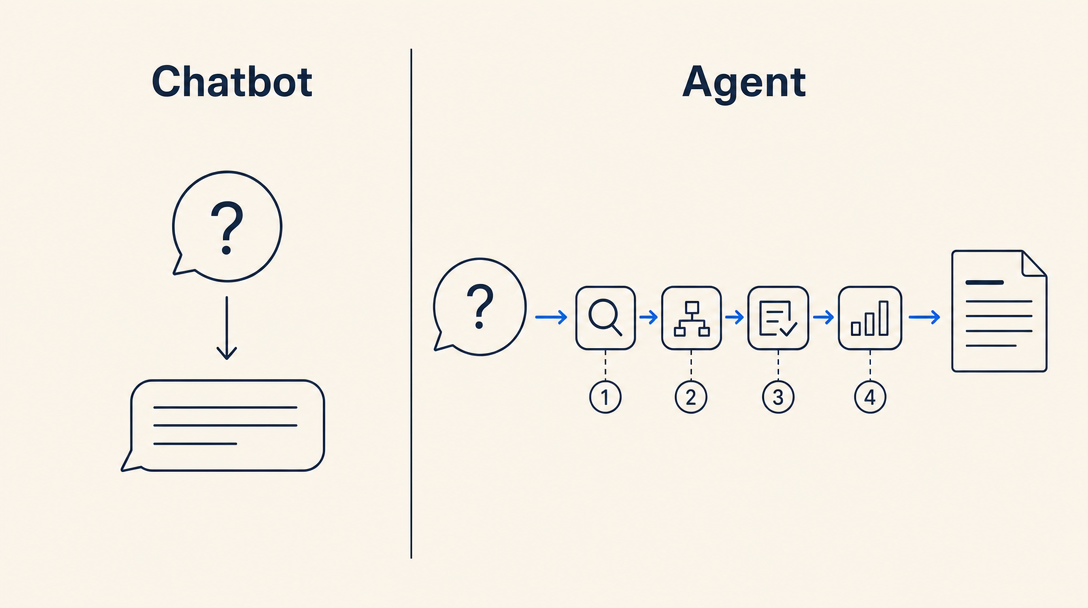
The simplest way to understand the difference between a chatbot and an AI agent is to compare what each one does for the same request.
You open ChatGPT and type: "I need to draft a contract for a new freelance client. Where do I start?"
A chatbot replies with a paragraph of general advice. Read carefully, restate the scope, define payment terms, etc. It is correct, generic, and only marginally useful. You still have to do all the actual work.
An agent set up for the same purpose does something fundamentally different. It asks you four questions: who is the client, what is the scope, what is the rate, what is the payment term. It uses your answers to produce a complete first-draft service contract, formatted as a real Word document, with the right freelancer-contract clauses (VAT 18% invoicing terms, payment timeline, IP ownership, indemnity, termination notice). It also gives you a list of things you should verify with a lawyer before signing.
The chatbot answers a question. The agent does a task. That is the entire distinction.
Three real Israeli examples (so the difference is concrete)
Freelance accountant preparing monthly VAT report. Chatbot: explains what VAT is. Agent: walks through the freelancer's monthly invoices, organizes them by the categorization the freelancer provided (VAT-charged, zero-rated, or exempt), helps double-check the totals, and flags anything that looks unusual for review before submission. (Note: chat-based agents are unreliable at arithmetic over long invoice lists; treat the totals as a draft to verify, not a final number.)
Solo lawyer drafting a service agreement. Chatbot: lists the clauses a service agreement typically contains. Agent: asks about the parties, the scope, the term, the governing law, and produces a complete first draft in both Hebrew and English with the standard Israeli clauses (jurisdiction, dispute resolution, IP ownership, termination), ready for the lawyer to edit.
Marketing manager researching Israeli competitors. Chatbot: lists generic competitor-research methods. Agent: takes the manager's product category, identifies the 5 main Israeli competitors, summarizes each one's positioning and pricing, lists their recent product launches, and produces a one-page strategic memo with three concrete recommendations.
In every case, the agent does work the chatbot only describes. That is what you are setting up.
The "stop typing into a chat box" moment
If you find yourself repeatedly typing similar long prompts into a chatbot ("Please summarize this email in Hebrew, formal tone, three bullet points, with a suggested reply..."), you are doing the agent's job for it. The whole point of an agent is to encode that long prompt ONCE, then use it many times by just dropping in the new email each time. Chapter 2 shows you how to do that on the three main platforms.
The most common mistake in Chapter 1: trying to make a chatbot do everything in one mega-prompt. Symptom: your prompts are 400 words long and you copy-paste them every time. Fix: that mega-prompt should be an agent's setup, not a daily message. Move it to a Claude Project, a ChatGPT GPT, or a Gemini Gem once. Use the agent for the daily work.
If you want a daily-reference companion for Israeli business context (work week, holidays, formal Hebrew email norms), install israeli-personal-assistant (npx skills-il add localization/israeli-personal-assistant). It pairs naturally with anything you build using this course.