When AI agents fail (and what to do)
AI agents fail in a small number of predictable ways. Knowing these patterns is the difference between an agent that saves you hours and an agent that quietly inserts errors into your work. This chapter names the five most common failure modes for Israeli users specifically, and gives you a verify-before-trust protocol.
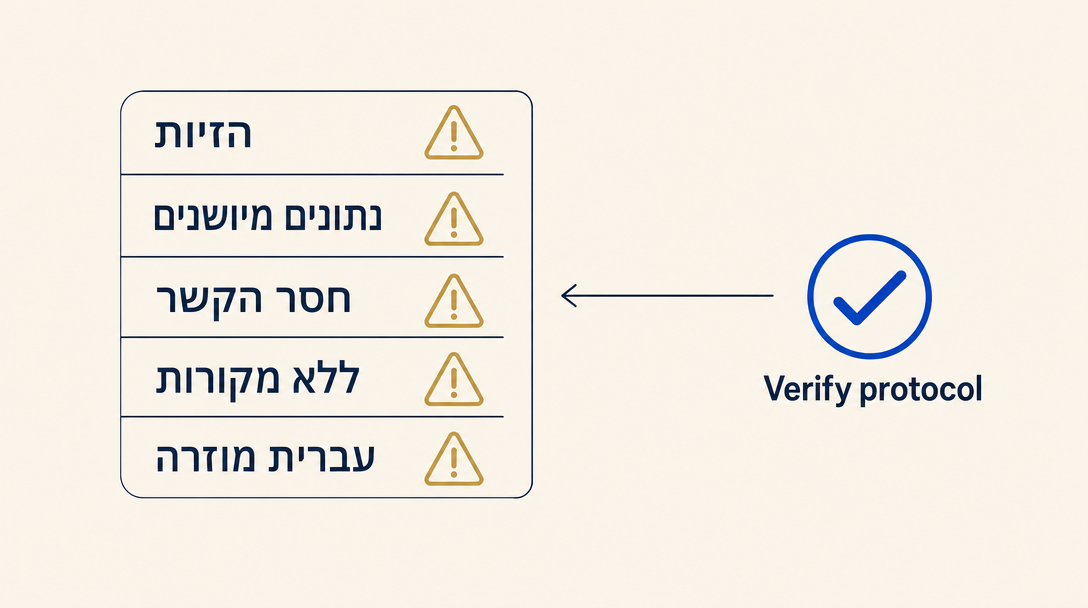
Failure mode 1: Hallucinated facts
The model invents a specific-looking detail (a form number, a tax threshold, a court case, a regulation citation) that sounds plausible but is not real. This is the most dangerous failure mode because it is invisible: the made-up fact slots smoothly into otherwise correct prose.
Concrete examples that have appeared in real AI output for Israeli users: invented Bituach Leumi form numbers, wrong tax brackets that the model confidently asserts, made-up Knesset bill numbers, and shifted-by-one section numbers in citations of Israeli laws (the model swaps a real section for a number that does not exist, with no indication of uncertainty).
How to catch: any time the agent quotes a specific number, name, regulation, or threshold, treat it as unverified. The verify protocol below applies.
Failure mode 2: Training cutoff (stale data)
The model's training data ends at some point in the past. For anything that changed since then (laws, prices, fund returns, political events, product launches), the model either confidently states the old value or hedges vaguely. Israeli regulatory data changes constantly; this is a near-permanent issue.
How to catch: ask the agent directly ("what year are you confident this number is from?"). If it cannot give you a specific recent year (2025 or 2026), the value is suspect.
Failure mode 3: Missing your specific context
The model gives a generally-true answer that is wrong for your specific situation. "The standard severance pay rate is..." is true for most cases and wrong if the employee is under a Section 14 arrangement under the Severance Pay Law (which substitutes ongoing employer contributions for an end-of-employment lump sum, and changes the calculation entirely). Generic correctness with specific wrongness is one of AI's most common failure modes.
How to catch: tell the agent the specifics of your situation explicitly, even details you think are not relevant. Then ask "does anything in my situation change the standard answer?"
Failure mode 4: No sources
The agent produces an authoritative-sounding answer with no citations. You cannot verify it. You cannot defend it if challenged. This is fine for low-stakes tasks (drafting a casual email) and dangerous for high-stakes ones (a tax position, a legal argument, a medical decision).
How to catch: ask "what is your source for that?". If the agent cannot point to a specific government page, statute, or authoritative document, treat the answer as a starting point for your own research, not a finished answer.
Failure mode 5: Biased or weird Hebrew output
Hebrew output that sounds like a translation, uses unusual word order, or makes Hebrew grammar mistakes (gender disagreement, wrong plural forms, calques from English). This is a register failure, not a factual failure, but it damages your credibility when the output goes out under your name.
How to catch: read the Hebrew aloud. Hebrew written by AI often reads "almost right." A native Israeli reader detects this in seconds. If anything sounds off, ask the agent to rewrite in natural Israeli Hebrew, then re-read aloud.
The verify-before-trust protocol
Run this protocol on any AI output you plan to act on:
- Spot-check one specific claim. Pick a number, a regulation, a name. Open the primary source (gov.il, kolzchut, official ministry page). Confirm the agent's claim matches. If it does not, the entire output is suspect.
- Ask the agent to challenge itself. "What is the weakest claim in what you just said?" Often the agent will name the exact thing you should not trust.
- Cross-check across two platforms. If Claude and ChatGPT both produce the same answer, your confidence goes up SLIGHTLY (modern frontier models share training data, so agreement is weak evidence). Primary-source verification (gov.il, kolzchut, official ministry pages) is the only strong evidence. If they disagree, dig deeper.
- Read it aloud (Hebrew especially). Catches register issues that silent reading misses.
- Time-box your trust. AI outputs about "current rates", "this year", "recently" decay fast. If the output is more than a week old, re-verify before relying on it.
When to escalate to a human
The "this is not advice" rule, in one sentence: if a mistake here will cost you serious money, legal trouble, health consequences, or a regulated penalty, do not trust an AI agent alone. Call a licensed professional.
Concrete escalation triggers:
- Any tax position where you are not 100 percent sure of the answer (even small amounts compound through penalties and interest) → CPA (ro'eh heshbon) or tax advisor (yo'etz mas)
- Legal documents that will be signed by any party → lawyer (orech din)
- Medical questions beyond information lookup → doctor
- Pension / investment decisions → licensed pension advisor (yo'etz pensyoni)
- Anything criminal, contested, or regulatory → professional in that domain
AI agents are excellent at preparing you for those conversations (organizing the question, drafting initial documents, summarizing options). They are not replacements for the conversations themselves.
The most common mistake in Chapter 5: trusting an AI's first answer because it sounds confident. AI agents are trained to sound confident even when they are wrong. Build the verify habit. It is the single highest-leverage skill in this entire course.
Want to keep reading?
Sign in to unlock the rest of the course and track your progress.