How to actually compare funds (fees + returns)
This is the chapter where you do the work. The official comparison tool in Israel is פנסיה נט (pensianet.cma.gov.il), run by the Capital Markets Authority. It is the only data source you can trust for fund-level comparisons because every fund is required to report to it. Bloggers, brokers, and YouTube influencers all derive their numbers from פנסיה נט or its sibling סופרמרקר (supermarker, run by The Marker which pulls from pensianet). Go to the source.
The six columns that actually matter
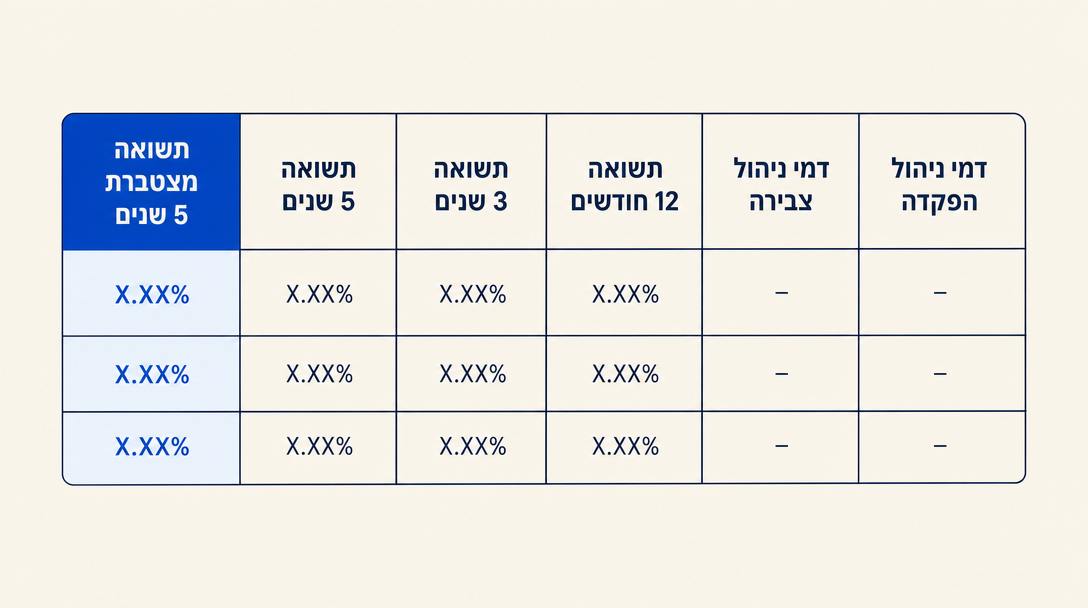
When you open פנסיה נט and view a fund's profile, there are dozens of fields. Six of them carry 95 percent of the signal:
| Column | What it tells you | Why it matters |
|---|---|---|
| דמי ניהול מהפקדה (deposit fee) | Percent of every new contribution taken by the fund | Charged on every monthly payment for 40 years. A 1 percent gap here compounds dramatically. |
| דמי ניהול מצבירה (accumulation fee) | Percent of your entire savings balance taken annually | The bigger your balance, the more this hurts. A 0.2 percent gap on ₪500,000 is ₪1,000/year. |
| תשואה 12 חודשים | Trailing 12-month return | Noisy. Useful only to spot something catastrophic. Do not switch funds on this number alone. |
| תשואה ממוצעת 3 שנים | 3-year annualized return | Better signal. Smooths most market noise. |
| תשואה ממוצעת 5 שנים | 5-year annualized return | The most reliable single column. Long enough to span a market cycle, short enough to reflect current management. |
| תשואה מצטברת 5 שנים | 5-year cumulative return | Easiest to compare across funds. This is what we use below. |
Why Israeli pension returns look lower than US 401(k) returns
A common confusion: a US 401(k) with an S&P 500 index allocation might show a 5-year cumulative return north of 80 percent. An Israeli pension fund's general track for the same period shows maybe 35-50 percent. That is not because Israeli fund managers are worse. It is because the Israeli state guarantees a yield floor on a portion of pension assets, which structurally caps equity exposure.
Until October 2022 the mechanism was called אגרות חוב מיועדות (designated bonds): the state issued special bonds that 30 percent of each fund's assets had to hold, paying a regulated yield. In October 2022 a reform (within the late-2021 חוק ההסדרים) replaced that with a new mechanism, מנגנון הבטחת תשואה (yield-guarantee mechanism): for new contributions, the state guarantees a 5.15 percent real annual return on 30 percent of fund assets through a dedicated reserve fund. Older money continues under the designated-bonds rule until those bonds mature. Either way, the practical effect for the saver is the same: 30 percent of your contributions are in a state-backed yield-floor sleeve, which is why your fund's headline equity exposure (and thus its upside in good market years) looks lower than a US 401(k) with a 100 percent equity allocation.
The 2025 single-year top performer in the equity track was Menorah Mivtachim's pension equity track at 21.8 percent for the year. Menorah's pension fund also ranked first in the 5-year cumulative comparison published at end of 2025 (around 81.4 percent cumulative). The equity track (מסלול מניות) is NOT the default for most employees. The default for most employees is the age-appropriate track (50- / 50-60 / 60+), where the regulated state-backed sleeve plus age-targeted equity allocation produces materially more conservative returns.
Past performance does not guarantee future results. The fund names above are mentioned to illustrate how to read the official פנסיה נט rankings; they are not a recommendation to choose any specific fund.
Worked example: fees over 30 years
Two pension paths, identical contributions (₪3,000/month, growing 2 percent per year), identical 5 percent annual gross return, different fees.
| Path | Deposit fee | Accumulation fee | Approximate ending balance after 30 years |
|---|---|---|---|
| Default fund (regulated cap) | 1.00% | 0.22% | ₪2.30M |
| Typical non-default with no discount | 2.50% | 0.50% | ₪2.03M |
The fee gap costs roughly ₪270,000 over 30 years on a single contributor. Doubled (couple), the gap is over ₪500,000. The fee column matters more than people think. The return column matters more still, but only if you actually check the 5-year cumulative figure rather than picking on last quarter's headline.
The "switching cost" trap
The marketing for pension switching firms (סוכני פנסיה / חברות סוכנות) emphasizes the savings from moving to a lower-fee fund. They are usually right. But three real costs of switching often go unmentioned:
-
Insurance underwriting and pre-existing conditions. Under the תקנון האחיד (standard regulation) for comprehensive pension funds, a direct transfer between two comprehensive funds preserves your original qualifying period (תקופת אכשרה), so pre-existing conditions covered by your current fund typically remain covered after the move. The risk is a BREAK in coverage: any gap (even brief) can reset the underwriting clock, re-exposing chronic illnesses to exclusion or higher pricing. If you have any pre-existing condition, do NOT initiate a transfer without first consulting a licensed pension advisor (יועץ פנסיוני) and getting written confirmation from the new fund about coverage continuity. The cost of consulting an advisor is trivial compared to losing disability or survivor coverage entirely.
-
Timing of the transfer. Some funds settle the transfer mid-month, others mid-quarter. A bad timing can mean 4-8 weeks where you have less coverage than you should.
-
Year-end accounting. Switching mid-year can complicate your annual tax statement (טופס 161). It is not a deal-breaker, but plan for the bookkeeping.
The most common mistake in Chapter 4: switching funds based on a single year's return number. The fix: always look at the 5-year cumulative column. If the 5-year cumulative gap between your current fund and the cohort leader is less than 5 percent (cumulative, not annualized), do not switch. The friction is not worth it.
For payslip-level verification that your employer is actually depositing the correct contribution amount (you would be surprised how often the deduction line and the actual deposit do not match), the israeli-payroll-calculator skill at https://agentskills.co.il/skills/israeli-payroll-calculator is the right cross-check tool.
Want to keep reading?
Sign in to unlock the rest of the course and track your progress.