End-of-year strategy
Q4 is not an operations quarter. It's a decisions quarter. Everything you do in October-November-December sets your April tax bill. Most freelancers treat Q4 like Q3 and discover in April they could have saved ₪5,000 to ₪25,000 in tax through simple decisions they didn't make in time.
A Q4 schedule
The quarter divides into four phases, each with one central decision:
| Week | What to do | Why |
|---|---|---|
| Early October | Read YTD: income through end of September, estimate annual total | This number drives every decision in the later phases |
| Mid November | Calculate expected marginal rate based on the forecast | Decide whether to pull or push expenses |
| Early December | Decide on keren hishtalmut and pension contributions | Last check before the year locks |
| Dec 28 to 31 | Section 46 donations, decision on the Dec 31 invoice | The final touch to cut the year |
The December decision checklist
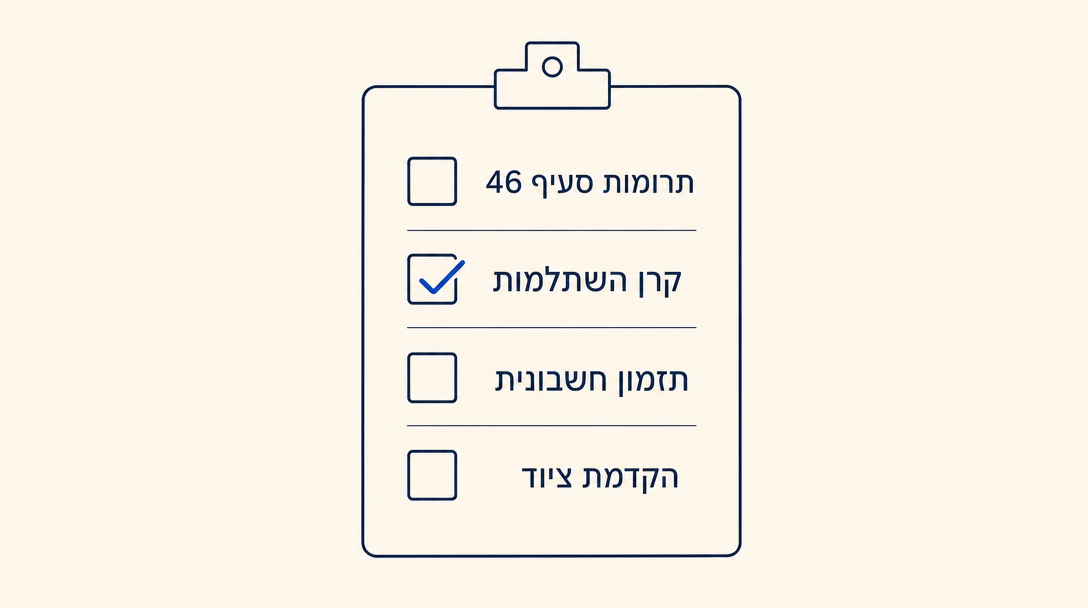
1. Section 46 donations. A donation to a recognized institution (Reshut HaMisim publishes the official list) generates a 35% credit on the amount, up to 30% of taxable income. A ₪3,000 donation = ₪1,050 direct credit on the tax bill. Deadline is December 31, and the donation must complete before midnight by charge date, not by intention. Verify the institution is on the list and that you have an official receipt with confirmation number.
2. Keren hishtalmut deposit for self-employed. If you haven't deposited yet, or deposited below the cap, you have until December 31. Pushing the deposit to December is common among freelancers who want "to see" how the year ends, and then forget. Set an internal deadline of December 20 for the final decision.
3. Timing of the year's last invoice. If a project closed in December and you choose when to invoice, the question is: which year will be the higher marginal rate, this one or next? Usually, if a freelancer's income rises year over year, it pays to defer invoices to January 1. If income is forecast to drop, it pays to issue before December 31.
4. Pulling equipment purchases. If you're planning to replace a computer, monitor, or other expensive equipment early next year, it can pay to pull the purchase to December if this year is at a higher marginal rate. The equipment enters depreciation at 33% in the year and helps with optimization.
The classic case: a big December
Sometimes you see in November that you have an unusually high marginal rate this year (a big project that won't repeat, or a structural change that bumped income). This is when you activate all the tools at once:
- Maximum keren hishtalmut deposit (₪19,500)
- Maximum self-employed pension deposit
- Planned Section 46 donation
- Defer every invoice possible to January
- Pull every planned expense into December
These five steps together can shave tens of thousands of shekels off the annual tax bill if your marginal rate is 47% or 50%.
The math on the year's last invoice
Say you have a project that closed on December 30 and you're deciding when to issue a ₪10,000 invoice. If you issue December 31:
- Income enters this year's books
- If your marginal rate is 35%, you pay ₪3,500 tax on it
- VAT (if osek murshe): ₪1,800 you'll remit next quarter
- Net to you: ₪10,000 - ₪3,500 = ₪6,500
If you defer to January 1:
- Income enters next year's books
- If next year forecasts a 31% marginal rate (lower income pace), you pay ₪3,100 tax
- Savings: ₪400 on the tax bill
The decision rests only on how accurate your next-year forecast is, and how much you care about pulling forward ₪6,500 (the invoice moved 24 hours, the actual payment happens when the client pays).
The most common mistake
The classic Q4 mistake: waiting on decisions until mid-December, seeing "there's time" until the 31st, and losing the window for keren hishtalmut (takes 5-7 business days at the bank) and for donations (must apply on date, not on intention).
The fix: pick an internal date, December 20, for all critical actions. After December 20 no bank transfers. The only exceptions are online credit-card donations (instant) and invoices you issue yourself.
Skills to install for this chapter
- Israeli Pension Advisor (
israeli-pension-advisor), for a final calculation of the keren hishtalmut and pension deposit accounting for actual annual income and marginal rate. - Israeli Freelancer Ops (
israeli-freelancer-ops), for automatic reminders on every December milestone (Dec 20, Dec 28, Dec 31).
What you should know after this chapter
- The 4 main Q4 decisions and their schedule
- How to calculate the value of the year's last invoice
- When to pull and when to push expenses
- A December checklist with an internal December 20 deadline
The final chapter focuses on tax season: how to close out the previous year without losing anything in the transition.
Want to keep reading?
Sign in to unlock the rest of the course and track your progress.