VAT cycle
Deciding your VAT reporting cadence is the highest-leverage administrative choice you'll make this year. It determines how many hours go into filings, when you get VAT back on expenses, and how your cashflow looks every other month. Most freelancers don't choose; they sit on whatever default was assigned to them by Reshut HaMisim. That's a missed opportunity.
Monthly or bi-monthly, the decisive table
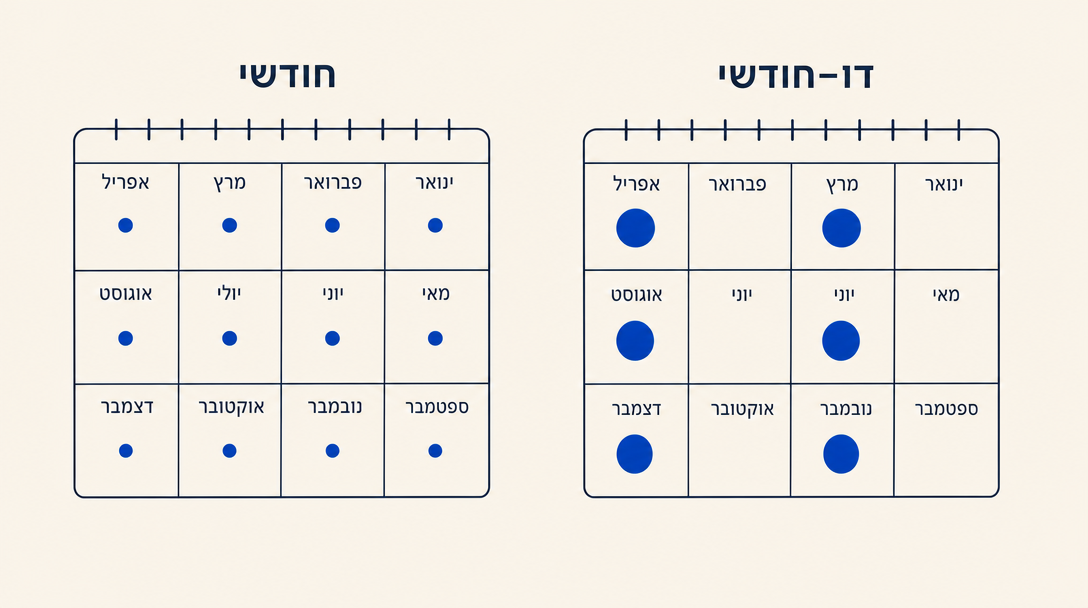
As osek murshe you can file VAT at two cadences. The difference is administrative and cashflow, not legal:
| Aspect | Monthly | Bi-monthly |
|---|---|---|
| Reports per year | 12 | 6 |
| Filing deadline | 15th of each month | 15th of each even month (Feb, Apr, Jun...) |
| Admin time per report | 30-60 minutes | 60-90 minutes |
| When VAT refund arrives | Within 30 days | Within ~60 days |
| Cashflow | Steady | Seesaw |
The choice is between a steady administrative drumbeat (monthly) and bigger, less-frequent hits (bi-monthly). Freelancers serving large business clients with low expenses benefit from bi-monthly, holding clients' VAT for 30-60 extra days. Freelancers stacking up business expenses (equipment, raw materials, osek murshe suppliers) benefit from monthly, getting input VAT refunded twice as fast.
How to switch cadence
Cadence changes are possible at the start of a year. The current cadence holds until you actively notify Reshut HaMisim. To move from bi-monthly to monthly for the upcoming year, file the request before January 31 of that year.
A simple decision rule once you have last year's annual report in hand: if input VAT (tashumot) was more than 50% of output VAT (askot), you're a clear candidate for monthly. If it was less than 30%, you're a clear candidate for bi-monthly. In between, it depends on how sensitive your cashflow is to the timing of VAT refunds.
How a VAT report is built
Every report has two main lines to know how to read:
- Output VAT (mas askot), all the VAT you collected from clients in the period (18% on net invoice amount).
- Input VAT (mas tashumot), all the VAT you paid suppliers on recognized business expenses (also 18% on supplier's net amount).
The difference between them is what you remit to Reshut HaMisim. If input VAT exceeds output VAT, you get a refund. Most freelancers see input VAT around 15%-25% of output VAT in a typical year.
The osek patur threshold trap
This is the most painful scenario in the VAT cycle and worth repeating. If you're osek patur and your annual revenue crosses ₪122,833 (2026 threshold per Reshut HaMisim) mid-year:
- You must convert your file to osek murshe within 30 days of crossing.
- Every invoice issued after the crossing must include 18% VAT.
- If you didn't add VAT to those invoices, you owe the 18% out of your own pocket; the debt won't disappear and the client already paid.
The number to remember: if your revenue forecast is within 15% of the threshold, start the year as osek murshe rather than osek patur. The hour or two per month of VAT admin costs less than the risk of retroactive conversion.
The most common mistake
The mistake most freelancers make: choosing bi-monthly in their first Q1 without checking if it fits, and then never revisiting. Result: either cash sitting with suppliers longer than necessary (high input VAT but on bi-monthly), or reports taking twice the necessary admin time (monthly with minimal expenses).
The fix: in mid-February, after you file your annual VAT summary (Jan 31 deadline), open last year's ratio of output to input VAT. If a different choice would have saved you 30 days of cashflow per cycle, start the cadence-switch process now.
Skills to install for this chapter
- Israeli VAT Reporting (
israeli-vat-reporting), to file the VAT report each cycle. Handles the split between askot and tashumot, calculates the difference, and prepares the file for upload to Reshut HaMisim's site. Especially useful on monthly cadence because it cuts admin time per report to roughly 15 minutes. - Israeli Freelancer Ops (
israeli-freelancer-ops), to remind you 7 days before every VAT deadline and track filing status.
What you should know after this chapter
- The right VAT cadence for your expense profile
- How to switch cadence for next year and by when
- What to do if you're osek patur on the threshold and what late conversion costs
- Last year's output-to-input VAT ratio as the primary indicator for your decision
The next chapter focuses on mkdamot strategy: when filing a tikun mkdamot is worth it and how much it saves you in Section 187 penalties.
Want to keep reading?
Sign in to unlock the rest of the course and track your progress.