Expense optimization across the year
A recognized expense doesn't save you 100% of the amount; it saves you your marginal tax rate on that amount. That's the difference between thinking about expenses as "I'm spending so I'm saving" vs. "this is an investment in my tax envelope." This chapter explains how to time expenses by your marginal rate and how to identify expenses that are genuinely recognized.
The first question: what's your marginal rate
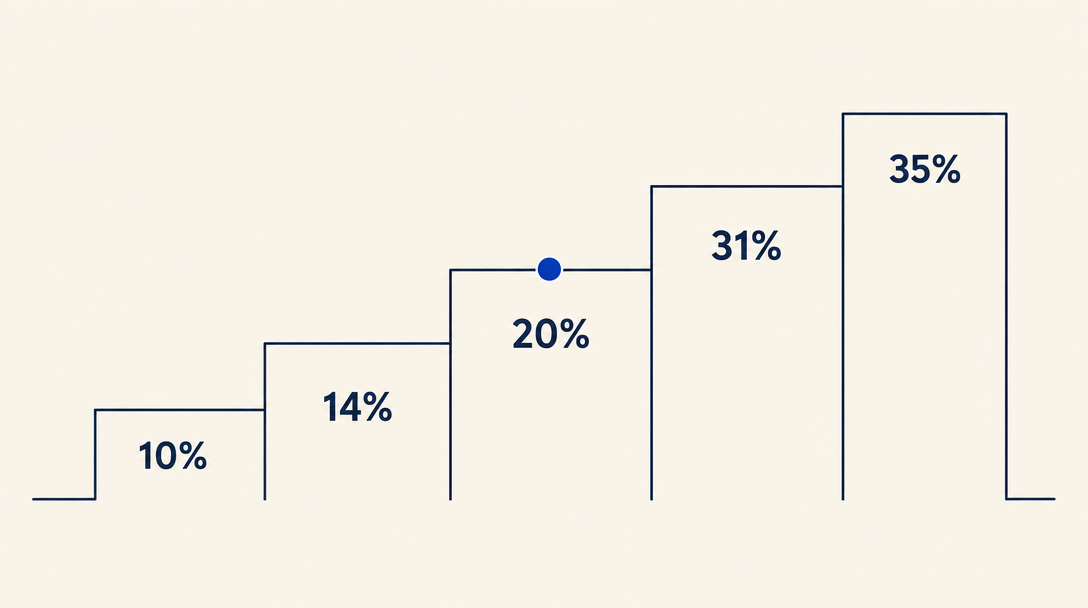
Before deciding on any expense, you need to know your marginal tax rate. That's the tax percentage that will apply to the next shekel you earn. Find it on last year's form 1301, or compute it from the 2026 brackets:
| Annual taxable income (₪) | Marginal rate |
|---|---|
| Up to 84,120 | 10% |
| 84,121 to 120,720 | 14% |
| 120,721 to 193,800 | 20% |
| 193,801 to 269,280 | 31% |
| 269,281 to 560,280 | 35% |
| 560,281 to 721,560 | 47% |
| Over 721,560 | 50% (plus 3% surtax) |
A recognized expense of ₪1,000 saves you:
- ₪140 if your marginal rate is 14%
- ₪200 at 20%
- ₪350 at 35%
- ₪500 at 50%
This gap is the core of expense optimization.
Categories of recognized expenses
1. Section 17, home office. If you work from home, you can deduct a proportional share of household expenses (electricity, water, arnona, internet, home insurance) based on the percentage of the room used as office. Example: 100 sqm apartment, 12 sqm workspace, deduct 12% of household expenses. Must document the calculation.
2. Equipment and depreciation. Professional equipment (computer, monitor, camera, office furniture) is depreciated over three years at 33% annually, unless it's equipment under ₪2,000 which can be fully depreciated in the year of purchase. Annual-subscription professional software is fully expensed in the year.
3. Vehicle. If the vehicle serves both work and personal use, roughly 67% of expenses (fuel, insurance, service) are recognized. That's the standard recognition rate for self-employed, and there's no need to prove it unless you want more.
4. Professional development. Courses, books, conferences, professional service subscriptions. Must be "within the specific profession" of your business, not a new field you're exploring.
5. Professional insurance. Professional liability, equipment property insurance, self-employed income insurance (under conditions).
6. Supplier services. Accountant, tax advisor, lawyer for business matters, cloud and software services, other freelancers you pay (they must issue you an invoice).
The magic of keren hishtalmut for self-employed
Keren hishtalmut for self-employed is one of the most powerful tools in your tax envelope:
- Annual contribution cap: 4.5% of annual revenue, up to a specific ceiling (around ₪19,500 in 2026).
- The entire amount is recognized as an expense and reduces taxable income.
- After 6 years the money is released free of capital gains tax.
The contribution must be by December 31 of that tax year. If your marginal rate is 35% and you contributed ₪19,500, you saved ₪6,825 in tax for the year. The money keeps earning tax-free returns for 6 years. The return on investment is roughly 38%-50% within 6 years, before the fund's own return.
Section 47, self-employed pension
Pension contributions for the self-employed are recognized up to a ceiling (around ₪22,000 in 2026), about two-thirds as a deduction and one-third as a credit. As a deduction: reduces taxable income. As a credit: you get a percentage of the contribution back directly. If your marginal rate is low, the credit is worth more. If it's high, the deduction is worth more. Your accountant or the matching skill will compute the optimal split.
Timing within the year
Expense timing affects its value. If you see year-end will land in a higher bracket than next year (a big project closed), it pays to push expenses to next year and pull invoices into this year. If reversed (next year forecasts higher income), pull expenses into this year.
The simplest rule: spend in the year your marginal rate is highest.
The most common mistake
The classic mistake: classifying non-recognized expenses as recognized. Common examples:
- Business meals that weren't business (you ate alone or with family)
- Clothes "for client meetings" that aren't formal uniforms
- Household appliances that serve work but not primarily
- Client gifts above ₪210 per person per year (above that, not recognized)
If an accountant or Reshut HaMisim audit comes back and disqualifies an expense, you'll pay not just the tax difference but interest and linkage differences, sometimes a penalty too. Better to be conservative.
Skills to install for this chapter
- Israeli Bank Connector (
israeli-bank-connector), for automatic categorization of all expenses from your bank account, saving hours of manual tagging at year-end. - Israeli Pension Advisor (
israeli-pension-advisor), for calculating optimal contributions to keren hishtalmut and pension by your marginal rate.
What you should know after this chapter
- Your marginal rate and how it affects the value of every recognized expense
- The 6 main expense categories allowed for self-employed in Israel
- The priority order between keren hishtalmut, pension, and operating expenses
- When to pull and when to push expenses between two tax years
The next chapter covers end-of-year strategy: decisions made in October-November-December that affect the April tax bill.
Want to keep reading?
Sign in to unlock the rest of the course and track your progress.