Mkdamot strategy
Most freelancers don't know they can change their mkdamot mid-year. They pay whatever Reshut HaMisim told them to pay, discover in April that it was way off, and get angry at an unexpected tax bill. Mkdamot are actually the most flexible tool in your calendar, if you know when to use them.
What mkdamot are
Mkdamot are two separate payments collected from self-employed people against future annual tax:
- Income tax mkdamot, calculated based on the tax you paid last year. If last year you paid ₪36,000 in tax, mkdamot would be ₪3,000/month.
- Bituach leumi mkdamot for self-employed, calculated based on last year's taxable income and the self-employed Bituach Leumi brackets.
Both payments transfer on the 15th of each month (monthly reporting) or 15th of each even month (bi-monthly). Both depend on prior-year data, and that's where most freelancers get stuck.
The problem with the default
Reshut HaMisim's default is: "about what you paid last year." That works if your income is similar year to year, but freelancers are volatile by default. If last year you made ₪200K and this year you'll make ₪150K, your mkdamot are set to ₪200K. You'll overpay every month and get the difference back only next April, holding 13 months of cash with the tax authority.
The other direction: if last year you made ₪150K and this year you'll make ₪250K, mkdamot at ₪150K don't cover it. You'll arrive in April with a big debt, and if it's more than 20% of the annual tax, you also incur Section 187 penalty (a late-payment penalty, around 5% of the gap).
Tikun mkdamot, the mechanism
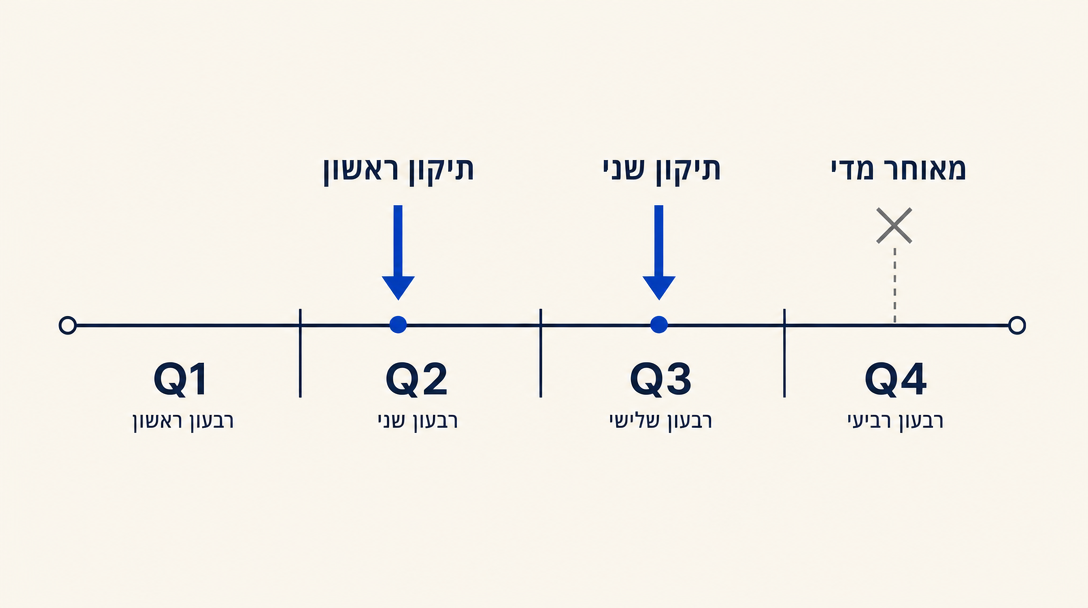
You're allowed to file a "mkdamot correction" once or twice a year and update the forecast. The form lives in Reshut HaMisim's online system, and the filing should include a brief explanation of the material change (new income pace, significant expense, business shift).
Optimal timing:
| Month | What to check | Result |
|---|---|---|
| May or June | Q1 results, see if annual pace is clarifying | First correction, adjusts the rest of the year |
| September or October | Q3 trend, catch shifts after the first correction | Second correction, adjusts the last 3 months |
| November onward | Too late | Creates accumulated debt, risk of Section 187 |
Decision tree for a correction
The Q2 question: how certain are you that the new income forecast differs from last year's annual?
- Different by more than 20% in either direction: file a correction immediately.
- Different by 10% to 20%: worth doing the math, usually yes.
- Different by less than 10%: defer to Q3 and check if the trend strengthened.
A worked example
Say in 2025 you had ₪200K taxable income and paid ₪40K tax. Reshut HaMisim set your 2026 mkdamot at ₪40K (₪3,333/month).
In Q1 2026 you see your pace is ₪150K annualized. The matching tax would be roughly ₪25K. If you don't file a correction, you'll pay ₪40K in mkdamot and get ₪15K back in April 2027 (13 months without the cash).
Tikun mkdamot in May 2026: drop mkdamot from ₪3,333 to ₪2,083. Eight months of saving ₪1,250/month in cashflow = ₪10,000 staying with you instead of with Reshut HaMisim. The April refund will reflect only the real overpayment of the first 4 months, around ₪5,000.
The most common mistake
The classic mistake: waiting on a tikun mkdamot "to see what happens." Freelancers start seeing a trend shift in May, worry they're wrong, and wait until end-of-Q3 to decide. By then 6 months of negative cashflow have passed that could have been avoided. Tikun mkdamot isn't a final decision; you can file another one after.
The fix: the moment you see a 20%+ gap from forecast at end of Q1, file a correction. Even if you have to revisit and update again at end of Q3, that's better than holding extra cash with Reshut HaMisim for half a year.
Skills to install for this chapter
- Israeli Tax Returns (
israeli-tax-returns), to quickly calculate the justified mkdamot based on current income pace and file the tikun mkdamot form. - Israeli Bituach Leumi (
israeli-bituach-leumi), to check whether your bracket in self-employed Bituach Leumi has shifted and whether to update that side too.
What you should know after this chapter
- The difference between income tax mkdamot and Bituach Leumi mkdamot
- When tikun mkdamot is worth filing (20%+ forecast gap)
- The Section 187 penalty and when it kicks in
- A simple calculation of how much money stays with you vs. with Reshut HaMisim
The next chapter is about expense optimization across the year, and how to choose between expenses that defer tax and those that improve the business.
Want to keep reading?
Sign in to unlock the rest of the course and track your progress.